Not every wildlife problem begins the same way, and not every wildlife problem should be handled the same way.
A raccoon entering an attic presents different considerations from squirrels chewing around a roofline. A bat exclusion requires a different approach from rodent entry-point sealing. Even when two animals appear to be using the same part of a house, their behaviour and access patterns can be different.
That is why species-specific wildlife control matters.
Ninja Wildlife Control's Houston-area service model is built around identifying the intruder, understanding its behaviour and using an appropriate removal and exclusion strategy. The company's species index includes raccoons, coyotes, rodents, Texas rat snakes, skunks, grey squirrels, brown bats and opossums.
For homeowners, understanding the difference can make it easier to recognise why professional assessment is often more useful than a one-size-fits-all response.
Raccoons: Larger Animals With Access to Sheltered Spaces
Raccoons can become particularly concerning when they gain access to attics or other protected areas of a home.
Because of their size and behaviour, their activity can create a more substantial disruption than a small animal moving through an exterior space. A homeowner may notice heavier movement, noises overhead or evidence of nesting.
Ninja's stated raccoon approach uses live trapping with one-way exclusion doors, followed by sealing entry points with galvanized steel mesh.
The key point is that removal is paired with exclusion.
If the access point remains available, the property may continue to attract wildlife.
Squirrels: Small Animals That Can Create Structural Vulnerabilities
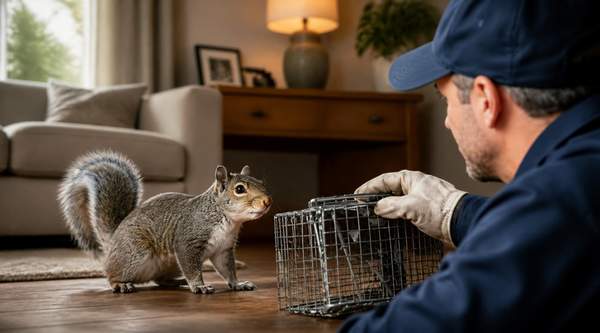
Grey squirrels are another common concern around residential structures.
Their ability to move through rooflines and other exterior areas means homeowners may notice activity before they ever see an animal inside the house. Chewed materials or recurring sounds around the attic can be warning signs.
Ninja describes its grey squirrel protocol as exclusion trapping with repeater traps, combined with reinforcement of chew points using steel plate.
That approach illustrates why the animal's behaviour matters.
Simply addressing the squirrel without considering the areas it has been using may leave the home vulnerable to another intrusion.
Bats: Exclusion Requires Timing and the Right Equipment
Bat problems can be particularly sensitive because the objective is not simply to capture an animal that has entered a home.
Ninja describes its bat-management approach as seasonal exclusion using one-way bat valves and a zero-contact methodology.
The emphasis on seasonal exclusion is important.
Bat exclusion can require attention to timing and access behaviour. Homeowners who discover bats around an attic, roofline or another part of the structure should avoid assuming that the same technique used for a squirrel or raccoon will be appropriate.
Professional assessment can help determine where bats are entering and how exclusion should be approached.
Rodents: Small Openings Can Become Big Problems
Rodents can take advantage of surprisingly small openings.
Ninja's species information identifies sealing entry points larger than one-quarter inch and eliminating harborage as part of its integrated exclusion approach.
That illustrates one of the major differences between wildlife species.
A homeowner may look at a gap and think it is far too small for an animal to matter. A professional inspection, however, evaluates potential access points according to the species involved.
For rodents, seemingly minor vulnerabilities can deserve attention.
Opossums and Skunks Need Different Considerations
Opossums can make use of protected spaces such as areas beneath decks and crawlspaces. Ninja describes live trapping and exclusion, including sealing these areas with heavy-gauge wire mesh.
Skunk management likewise requires attention to where the animal is sheltering. Ninja identifies live trapping, odor-control protocols and exclusion of dens under structures as part of its stated approach.
Again, the broader lesson is that wildlife control is not simply about removing an animal.
The property and the species have to be considered together.
The Inspection Comes Before the Solution
Homeowners sometimes try to identify the solution before they have identified the problem.
A noise in the attic might be assumed to be squirrels. An animal seen near a roof might be assumed to be a raccoon. Something flying out of an opening might immediately be labelled as a bat.
Those assumptions can lead to the wrong response.
Ninja's inspection process is designed to examine the property envelope, including the roofline, foundation, soffit, fascia and potential entry points. The company states that these areas are documented and photographed during inspection.
That creates a clearer basis for deciding what needs to happen next.
Removal, Restoration and Fortification Work Together
Once the species and access point are understood, the solution can extend beyond removal.
Ninja's process uses four stages: inspect, exclude, restore and fortify. Its restoration services include insulation replacement, wiring inspection, structural repair and sanitisation of contaminated materials, while fortification involves sealing potential entry points with materials including galvanized steel, heavy-gauge mesh and commercial-grade sealant.
This approach treats wildlife intrusion as a property-management problem as well as an animal-management problem.
The objective is to address the immediate intrusion while also dealing with the conditions that allowed it to happen.
When Should Houston Homeowners Call?
An inspection can be worthwhile when you notice:
- Scratching, movement or chewing sounds
- Wildlife entering or leaving an attic
- Animals repeatedly gathering around one part of the roof
- Droppings or nesting material
- Damaged insulation
- Chewed or damaged exterior materials
- Openings around the soffit, fascia or roofline
- Wildlife returning after an earlier removal
The sooner the source is understood, the sooner the homeowner can make an informed decision about removal, exclusion and restoration.
The Right Wildlife Solution Starts With the Right Identification
A raccoon is not a squirrel. A bat is not a rodent. An opossum is not a skunk.
Their behaviour, access patterns and appropriate management approaches can differ, which is why species-specific wildlife control is so important.
Ninja Wildlife Control provides wildlife removal, exclusion, attic restoration and damage repair for Houston and surrounding areas. The company offers free inspections and lists same-day and emergency service availability.
If wildlife has found its way onto or into your property, identifying the intruder is only the beginning. The next step is understanding how it got there, what it may have affected and how the home can be better protected going forward.