Summit County residents can research their neighborhood's history through a small set of accessible local institutions: the Akron-Summit County Public Library's Special Collections, the Summit County Historical Society's archives, and the Summit County Fiscal Office's online property portal. The right starting point depends on the question you are asking—whether you want to know who lived at an address in 1920, what a street looked like decades ago, or how a property's value and ownership have changed over time. This guide walks through each resource and shows how to combine them into a single research workflow.
Starting Your Summit County History Journey
Every neighborhood investigation begins with a question, and in Summit County the answers are concentrated in a few well-organized collections. The Akron-Summit County Public Library's Special Collections division holds the area's historic city directories, telephone directories, and archival materials, and it shares an Archives Catalog with the Summit County Historical Society that indexes both institutions' holdings. The library describes its city directories as excellent sources of information about Akron and the surrounding area, including statistical information about the city, classified business sections, and information about clubs, organizations, and churches.
For property questions, the Summit County Fiscal Office maintains the county's tax maps and real estate records through its online property search portal. The Fiscal Office states that its website connects residents with the right people for questions about real estate taxes and property values. Together, these institutions cover the three pillars of neighborhood research: people, places, and property—all without special permissions or private collections.
Summit County History Research Navigator
Use this matrix to match your specific question to the best local resource before you begin searching. Each row pairs an information goal with the primary Summit County resource, how to access it, and what it provides.
| Information Goal | Primary Resource | Access Method | Key Information Provided |
|---|---|---|---|
| Who lived or worked at an address, and when | Akron-Summit County Public Library's historic city directories | Online via Internet Archive for older volumes; in person at Special Collections for later directories and criss-cross directories | Resident occupations, spouse's names, business owners and corporate officers, plus street listings by address |
| What a building, street, or neighborhood looked like | Summit Memory digital collections | Online through the Summit Memory website | Historic photographs, documents, newspapers, artifacts, and audiovisual resources from the library and partner organizations countywide |
| How a property's value, sales, and land have changed | Summit County Fiscal Office property search portal | Online through the Fiscal Office's property access site | Value history, sales, tax history, sketch and land details, permits, and recorded documents |
| What archival materials exist on a topic | Archives Catalog (Library and Summit County Historical Society) | Online catalog search; finding aids available as PDFs | An index to both institutions' archival collections, including many individual collections with dedicated finding aids |
The logic behind the matrix is straightforward: directories answer questions about people and businesses tied to addresses, Summit Memory answers visual and documentary questions, and the Fiscal Office answers questions about the property itself. The Archives Catalog serves as a cross-institutional index when you are not yet sure what materials exist. Note that the catalog is an index only—it does not include images of the materials it lists.
Step-by-Step: Navigating Online Digital Archives
Two online collections let you begin research from home. The first is the set of Akron city directories on Internet Archive. According to the library, the linked volumes display in the Internet Archive viewer, and to search within a text you select the magnifying glass icon on the left side of the viewer. To read a directory in other formats, including PDF, you choose from Internet Archive's download options. To search across many directories at once, visit the Akron and Summit County (OH) Directories collection on Internet Archive and select "Search text contents."
Once inside a directory, use the street directory section—which most city directories include—to look up your address directly, since it lists residents and businesses by address rather than by name. Resident listings generally include the person's occupation and spouse's name, while business listings often name owners or corporate officers.
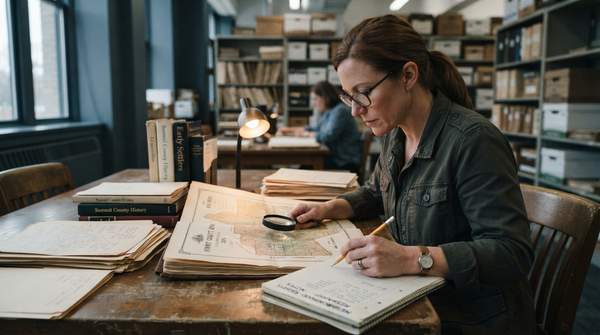
The second collection is Summit Memory, the library's digital archive of historic photographs, documents, newspapers, artifacts, and audiovisual resources drawn from the library and partner organizations throughout the county. Search it by street name, neighborhood, business name, or landmark to find visual evidence of how an area developed. For materials not digitized, the Special Collections research room holds later directories, Haines Akron City and Suburban Criss-Cross Directories, and Akron-area telephone directories from 1914 to the present.
Uncovering Architectural History with Local Records
Local records supply the raw data points that make architectural interpretation possible. The Fiscal Office's property portal organizes each parcel's record into sections including values, value history, sales, sketch, land, permits, and recorded documents. A property's value history and sales record can indicate periods of significant change, while the sketch and permit sections document structural details and modifications. The portal also offers a parcel viewer map and a neighborhood sales report for comparing properties on your street.
Pairing these property details with Summit Memory photographs lets you see how a building appeared at different points in its life, and city directories establish who occupied it and when. With a construction period and visual evidence in hand, you can then consult general architectural style references—such as those published by national institutions—to identify the period and style your building reflects. This article covers how to find the records, not the legal meaning of deeds or ownership, so treat property documents as historical evidence rather than legal advice.
Your Next Steps in Summit County History
Begin your neighborhood history research by using the Summit County History Research Navigator above to match your first question to the best resource, then work through the online archives before visiting Special Collections in person. A practical measure of progress is the successful retrieval of specific historical data: a resident's occupation from a city directory, a historical photograph from Summit Memory, or a property's sales history from the Fiscal Office portal. Each retrieved record—a name, an image, a sale date—becomes a thread you can pull to reveal how your corner of Summit County came to be the place you know today.
Sources
- Archival Collections — Akronlibrary
- Property Tax & Appraisal — Propertyaccess
- Historic City Directories — Akronlibrary
- Summit County Fiscal Office — Fiscaloffice