You can identify nearly any unknown plant in Summit County, Ohio, with three free tools that Summit Metro Parks itself recommends: iNaturalist, the USDA Plants Database, and the BONAP native plant checker. The process matters because native plants — species that evolved in a region over hundreds or thousands of years without human introduction, as the Summit, New Jersey environmental commission defines them — provide food and shelter for insects, birds, and other wildlife, and their conservation is essential to maintaining ecological balance. Learning to tell a native plant from a non-native one, or from a regulated noxious weed, is the first practical step a resident or visitor can take toward supporting local biodiversity.
Why Native Plants Matter in Summit County
Summit Metro Parks frames the stakes in direct, community terms: humans are part of nature, and when the plant and animal communities around us are healthy, it helps us thrive as well. The park district's Wild Back Yards initiative asks residents to make changes in their own outdoor spaces to help wildlife and counteract the effects of habitat loss and habitat fragmentation — two pressures that steadily shrink and isolate the green corridors local species depend on.
The ecological logic is straightforward. Native plants, having co-evolved with local insects, birds, and other wildlife, supply the food and shelter those animals actually need, forming what a beginner's guide from One Stop Garden Shop calls the backbone of ecosystems that support wildlife and maintain natural biodiversity. Recognizing native species also deepens your connection to the local environment, that guide notes, and can aid conservation efforts by helping preserve and restore natural habitats. In a county where yards, parks, and road edges together form a patchwork of habitat, every correctly identified plant is a piece of information about whether that patchwork still works for wildlife.
Essential Digital Tools for Plant Identification
Summit Metro Parks keeps a short, deliberately practical list of identification tools on its Wild Back Yards page: iNaturalist, the USDA Plants Database, and the BONAP native plant checker. Each answers a different question, which is why using them in sequence works better than relying on any one alone.
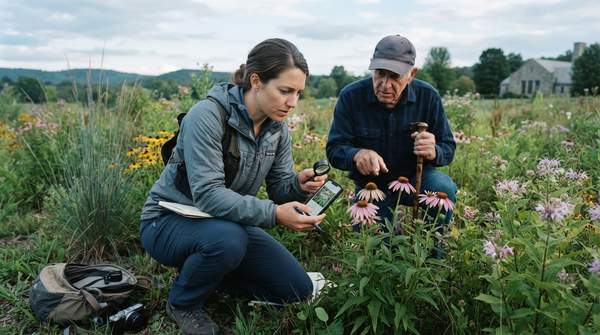
iNaturalist is the field tool. You upload a photograph of the plant, and the platform's community of naturalists suggests and verifies an identification — a photo-based approach that general identification guides describe as especially useful for challenging cases. The USDA Plants Database is the reference work: a comprehensive federal record where you can cross-reference a species and confirm its characteristics and native range. BONAP, the Biota of North America Program, answers the final question — whether a plant is genuinely native to your region and where it naturally occurs. Together they move you from "what is this?" to "does it belong here?"
Native Plant Identification Checklist for Summit County
The workflow below sequences the recommended tools from first observation to confirmed native status. It is a synthesis of the tools Summit Metro Parks recommends and the general observation steps identification guides describe, rather than a single published procedure — but each step uses free, authoritative resources.
| Step | What to Do | Tool or Method | What You Learn |
|---|---|---|---|
| 1. Observe and document | Photograph the whole plant plus close-ups of flower and leaf | Phone camera; note petal count, flower arrangement (solitary, clustered, or spiked), and bloom timing | The key features that drive any identification |
| 2. Get a first identification | Upload the photos and record location | iNaturalist | A community-verified species suggestion to work from |
| 3. Cross-reference the species | Look up the suggested species and compare its described traits | USDA Plants Database | Confirmation that the plant's characteristics match the suggestion |
| 4. Confirm native status | Check the species' native range and distribution | BONAP native plant checker | Whether the plant is native to your area of Ohio |
| 5. Check local context | Compare against regional noxious weed lists and ask local experts | County weed classifications; local nurseries, botanical gardens, and conservation groups | Whether the plant is regulated or invasive where you live |
Two habits make the workflow reliable. First, record the blooming period — knowing when a plant flowers is a significant identification factor, as the beginner's guide notes. Second, watch growth patterns: non-native species often spread rapidly or flower at unusual times compared with the regional flora, so familiarizing yourself with common local natives makes the outliers easier to spot.
Differentiating Native Plants from Noxious Weeds
Identification is not only about appreciating natives; it is also about recognizing plants that local governments classify as harmful. Summit County, Utah offers a clear illustrative example of how such classification systems work, sorting noxious weeds into tiers by how established they are and how urgently they must be addressed.
At the top are Class 1A Early Detection Rapid Response plants — species not known to be in Summit County, Utah, but thought to be present in neighboring states, where swift eradication of any found population is a very high priority. Next come Early Detection plants, which occur in the county at very low levels and are a high priority to eradicate and prevent from spreading. Control plants have a reasonable distribution in the county but do not occur everywhere, and should be given a high priority for control. Finally, Contain plants are widely distributed in the county; their current populations should be contained to halt their spread, and they should not enter commercial channels.
The lesson transfers to Ohio: before assuming an unfamiliar plant is a welcome native, check whether your county or state regulates it. Invasive non-native species can significantly disrupt local ecosystems, and distinguishing them from natives is as much ecosystem management as botany.
Your Role in Supporting Local Biodiversity
Summit Metro Parks emphasizes that participation does not require acreage. Whether you have sprawling land or a small front porch, you can join Wild Back Yards — planting a container garden or adopting a local garden space if you lack a traditional yard. The park district also maintains a list of vendors that have met its criteria as trusted sources for native plants, since plants cannot be dug up from the parks themselves.
Identification is the entry point to all of this. You cannot choose native plants for a yard, report a suspicious weed, or notice habitat fragmentation on your own street until you can put names to what grows there.
Empowering Local Biodiversity Through Identification
The practical decision this guide supports is to actively identify and differentiate native plants from noxious weeds in your local green spaces using the recommended digital tools — iNaturalist for a first identification, the USDA Plants Database for cross-reference, and BONAP to confirm native status, with county weed classifications as the contrast case. The measurable indicator of success is increased community engagement with plant identification platforms and local conservation initiatives such as Wild Back Yards. A reasonable next milestone: identify one unknown plant in your yard or a nearby park through the full workflow, confirm whether it is native to Summit County, and log the observation on iNaturalist, where it becomes part of the shared record local naturalists and the park district can build on.
Sources
- Wild Back Yards - Summit Metro Parks
- Native Plants — Cityofsummit
- An Introductory Guide for Beginners on How to Identify Native Plants — One Stop Garden Shop
- Noxious Weed Identification | Summit County, UT - Identify and Report Invasive Plants — Summitcountyutah